
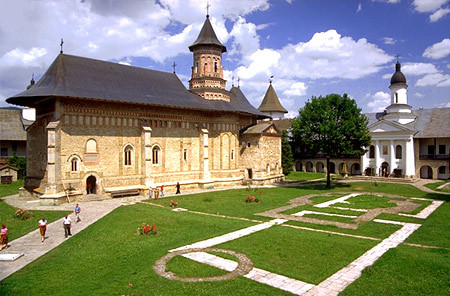
Camino and Via Mariae, the international ecumenical tourism itineraries, are taking shape in Neamț, aiming to promote the region guarded by Mount Ceahlău.
Camino is a route that ends at the cathedral in Santiago de Compostela, the capital of the Spanish province of Galicia, where the remains of the Apostle James are located, while the Via Mariae route is dedicated to the Virgin Mary.
The first route, in the Roman area, allows pilgrims and tourists to travel a path that leads them to museums, archaeological sites, and monastic objectives in 19 localities across Neamț County.
In Eastern Europe, the Camino ecumenical tourism path starts in Iași, on a route totaling approximately 4,500 km. The circuit passes through localities in Iași, Neamț, and Bacău, then crosses the mountains into Transylvania via the Oituz Pass toward Covasna and from there toward the countries of Western Europe.
Via Mariae is also a pilgrimage path through Central and Eastern Europe, forming a cross on the map of the continent. The itinerary includes territories in Austria, Hungary, Romania, Slovakia, Poland, Croatia, and Bosnia. Recently, the Vânători Neamț Natural Park was included in it. In Romania, Via Mariae used to end at Șumuleu Ciuc, in Harghita.
In Neamț, tourists and pilgrims wishing to travel the Via Mariae route have the opportunity to see famous secular monasteries (Pângărați, Văratec, Sihla, Secu, Sihăstria, Neamț), the memorial houses of Alexandru Vlahuță, Mihail Sadoveanu, Ion Creangă, Veronica Micle, the Neamț Fortress, and Lake Cuiejdel, the newest natural dam lake in Romania.
Frequently Asked Questions
What is the significance of the Via Mariae route?
Via Mariae is an international pilgrimage route dedicated to the Virgin Mary, crossing Central and Eastern Europe to form a cross-shaped path on the map.
Which major landmarks in Neamț are included in these routes?
The routes include historic monasteries like Văratec and Neamț, the Neamț Fortress, memorial houses of famous writers, and natural sites like Lake Cuiejdel.
Where does the Camino route lead?
The Camino de Santiago is a world-renowned pilgrimage route that concludes at the Cathedral of Santiago de Compostela in Spain, the burial site of Saint James the Apostle.