
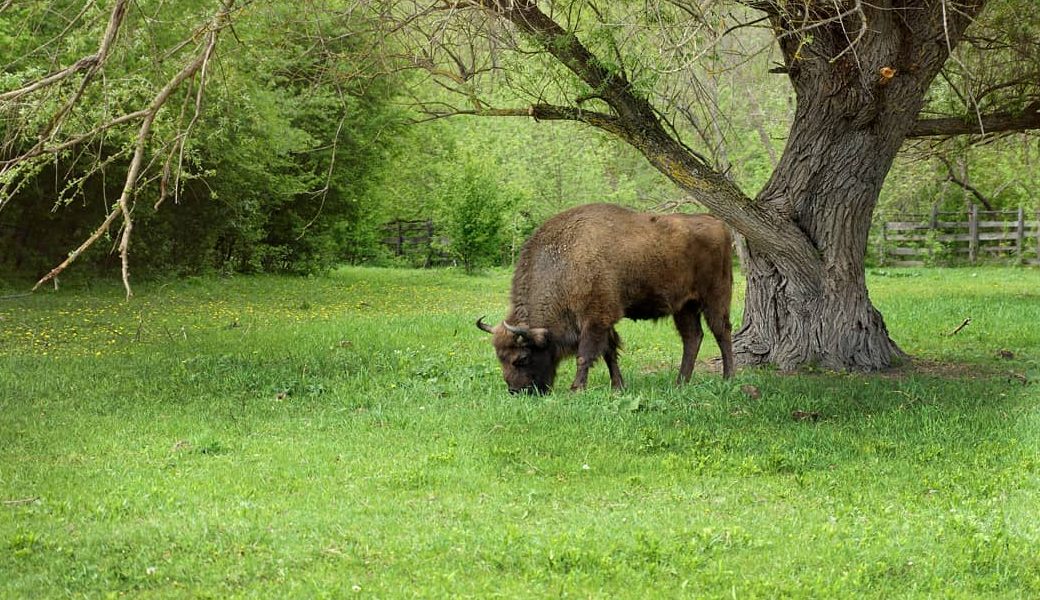
“Pădurea Domnească” is the largest reservation by area in the Republic of Moldova, covering 5,920 ha, and includes several tourist attractions in the north of the country: the Butești Gorges, Stânca Mare, One Hundred Mounds, the Bison Sanctuary, ancient oaks, the Land of Herons, and the “La Fontal” eco-tourism guesthouse, which serves as a relaxation point for tourists. The most significant attraction, however, remains the Bison Sanctuary, which currently houses seven mammals.
The “Pădurea Domnească” Reserve was established on July 2, 1993, according to a Decision of the Government of the Republic of Moldova, with the aim of preserving the most representative natural forest complex of meadows and marshes located in the middle sector of the Prut River, conserving and regenerating rare species of plants and animals, and promoting ecological recovery and the restoration of meadow ecosystem biodiversity.
From a geomorphological perspective, the territory occupied by the forest vegetation of the “Pădurea Domnească” reserve belongs to the North-Western Moldovan Plateau and is located in the middle course of the Prut River and its tributary Camenca, from the village of Braniște in the north to Pruteni in the south; it is bordered to the west by the Prut River and to the east by the Butești-Cobani reef zone and further south by the Prut River terraces near the eastern outskirts of the villages of Viișoara and Pruteni.
Currently, based on geomorphological characteristics, the territory is identified as the Alluvial Plain of the Middle Prut. Its composition includes the terraces of the Prut and elements of the current relief: the meadow and the left slope of the Prut valley and the water divides.
Depending on the degree of flooding and alluvium, four meadow plant associations are identified: oak forests, poplar forests, willow forests, and osier beds. Oak forests occupy an area of 1471.4 ha (26%), growing on the highest points in the meadow at altitudes of 53-60m. Willow forests occupy 455.6 ha, distributed along the Prut riverbed and occasionally in backwaters, formed on young, predominantly sandy and sandy-loamy soils. Poplar forests occupy 1081.6 ha; poplar communities formed on slightly higher ground than the willow forests and represent a transitional form from willow to meadow oak forests. Osier beds occupy small areas in the contact zone between the terrestrial space and the Prut River waters, forming on young, sandy soils under wet and very wet conditions.
It is notable that the reserve’s flora includes approximately 31 species of rare plants, of which 12 species are included in the Red Data Book of the Republic of Moldova and 19 species with varying degrees of threat are included in the IUCN Red List Categories.
The fauna of the “Pădurea Domnească” Reserve is rich and varied. It consists of 47 mammal species, 15 species of reptiles and amphibians, and 159 bird species, of which 21 species are categorized as rare animal species.
The European bison are of major importance to the reserve. Based on an interstate agreement between the leadership of the Republic of Moldova and Poland, the decision to re-acclimatize the bison in our country was made in 2005. As a result, on August 19, 2005, three bison (one male and two females) were brought to the reserve from two reserves in Poland.
The maintenance conditions for the bison in the reserve were created in accordance with the “European Bison Conservation Strategy” of the World Wildlife Fund (WWF), with recommendations from the Institute of Zoology of the Academy of Sciences, the Ministry of Ecology, and the Veterinary Service of the Ministry of Agriculture.
Annually, the reserve is visited by about 6-7 thousand tourists, school students, and university students, especially those from geography, biology, and forestry departments, who conduct their field practice on the reserve’s territory.
Frequently Asked Questions
What is the main tourist attraction in the Pădurea Domnească Reserve?
The main attraction is the Bison Sanctuary (Zimbrăria), which currently hosts seven European bison as part of a specialized re-acclimatization program.
How large is the reserve and where is it located?
It is the largest reserve in Moldova, spanning 5,920 hectares along the middle course of the Prut River in the northern part of the country.
What types of ecosystems are preserved in this area?
The reserve protects a diverse complex of meadow and marsh forests, including unique associations of oak, poplar, willow, and osier beds.