

On January 30-31, the HOTCO conference took place in Budapest, the first conference dedicated to hotel investments focused on Central and Eastern Europe plus the Caucasus. The event, featuring approximately 70 speakers, was appreciated by over 300 delegates from 35 countries as being very useful for institutional and non-institutional investors who previously found it difficult to obtain detailed information about countries in the region at the Berlin event, which takes place at the beginning of every March and covers the phenomenon at a global and European level.
Alexandru-Sorin Ionescu, founder and director of Fivestar Hospitality and representative in Romania for Horwath HTL, was invited by the conference organizers to moderate a discussion about Romania, presenting key data points of interest to investors.
“I believe I managed to draw the audience’s attention to Romania—an audience already accustomed for several years to analyzing investments in Poland, Hungary, and the Czech Republic. They learned that the size of the country matters significantly, with Romania having three-quarters of Poland’s surface area, and that Romania should be viewed as POLAND II.”
The main arguments presented during the discussion, which included Emeline Sykora-Wintrebert, Development Director for ACCORHotels SEE, Bogdan Stanciu, founder and director of BITSOFT, Anca Pavel-Nedea, former president of ANT 2015-2016, and Darren Blanchard, Development Director for Carlson Rezidor, were economic in nature:
- January 20, 2017 FITCH: BBB- stable outlook (investment grade – level 1 out of a maximum of 4) based on expected economic growth for 2017 and the stability of the banking sector;
- The sixth consecutive year of recorded economic growth. 2016 GDP growth of 4.8%, the highest since 2008;
- FDI growth in 2016 by ~22% after a 25% increase recorded in 2015. The absolute figure for 2016 was ~EUR 4.2 bn. Government debt ~38%;
- Statement by US Secretary of State Rex Tillerson during American Congressional hearings on January 12: “I will continue to support our commitment to install adequate defensive systems to defend Romania”;
- GDP/capita in Bucharest is EUR 22,400, a level already comparable to Warsaw and Budapest. The same demographic level as Vienna. Airport traffic comparable to Budapest, Warsaw, and Prague, with traffic at OTP recording a 17% increase in 2016.
- Organization of upcoming events related to SIBIU – European Region of Gastronomy in 2019, BUCHAREST – host city for matches in UEFA EURO 2020; TIMISOARA – European Capital of Culture in 2021.
Another important message was launched by the moderator and supported by the representative of the Accor hotel group regarding the situation of hotel transactions in Romania:
- Romania represents a young transactional market in the hotel field, with limited transactions in recent years such as City Plaza (85 keys) in Cluj-Napoca or the recent Amfiteatru-Belvedere-Panoramic transaction where Mr. Mohammad Murad, owner of the Phoenicia group, took over the 700 keys from Josef Goshy, owner of UNITA TURISM, planning total investments of ~EUR 25 million in the ~700 keys of the complex, which will be reclassified to 4 stars.
- The main problem, with a few exceptions, is the apparent lack of foreign capital interest in purchasing properties with conversion potential or developing new projects. The main reason is related to the exit perspective; the market does not seem liquid enough for institutional or non-institutional investors, some of whom are already present in a real estate investment market recently valued by a specialized firm at EUR 890 million, up 35% in 2016, with 70% of the value realized in Bucharest. The component sectors are: 45% offices, 26% retail, 26% industrial, and 3% others, where hotels should be included.
- Alexandru Sorin Ionescu stated that to encourage foreign investors, he launched a “supermarket” portal for hotel investment opportunities at the end of last year, HOTELSFORSALE.RO, where potential foreign and Romanian buyers can find the most important opportunities selected by a market expert, with significantly reduced effort in identification, networking, and contact with intermediaries, etc.
- The issue of the sales yield in the hotel sector was discussed, identifying that the theoretical yield valid for Bucharest should be approximately 150BPs above that of the office sector => 9%, but this remains to be confirmed through notable transactions.
- Financing for real estate investments has improved in terms of terms and conditions over the last year, closely approaching the level of conditions in other Eastern European markets.
- Anca Pavel-Nedea stated that, from her point of view, the lack of liquidity also stems from unrealistic prices requested by sellers who are trying to recover past investment underperformance, expensive land purchases, construction at higher prices than today’s, etc.
Another topic addressed during the discussion referred to the prospects of tourism in Romania and the exceptional fiscal facilities we can boast about on a European level:
- Decrease in January 2015 of the VAT level from 24% to 9% for all services bundled with accommodation;
- Decrease in June 2015 of the VAT level from 24% to 9% for all food products and services;
- Decrease of the general VAT level from 24% to 20% in 2016 and more recently to 19% at the beginning of 2017;
- The voucher law that stimulates the consumption of tourism services addressed to Romanian clients from the private sector (started 2016) and public sector (currently postponed);
- The specific profit tax introduced in October 2016, which brings benefits by calculating it based on operated square meters, location, and other variables;
- The new fiscal measure through which the 16% income tax for employees in industries where the specific tax applies is exempt, with prospects of widening the area of exemptions in the near future;
- Anca Pavel-Nedea also highlighted the impact she believes the implementation of the destination management system in Romania will have—a project she personally handled alongside establishing a clear action strategy for the coming years and calculating the necessary promotion budget for the next few years, estimated at approx. EUR 15 million/year.
- All these measures have caused tourism to record significant growth in recent years, with similar expectations until 2020:
- o the average growth in Bucharest of the number of foreign arrivals in the period 2007-2015 was 7.9%, but 18% in 2014 alone, 14% in 2015, and 10% in 2016;
- o the average growth in Romania of the number of foreign arrivals in the period 2007-2015 was 4.7%, but 11% in 2014 alone, 17% in 2015, and 10% in 2016;
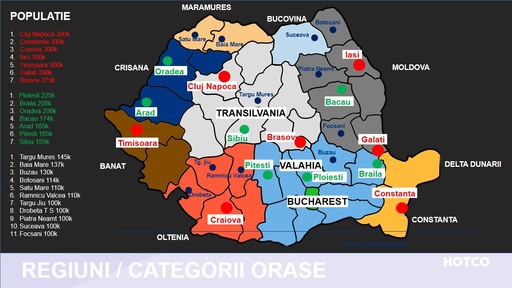
The discussion reviewed Romania’s extraordinary attractiveness due to the existence of secondary and tertiary cities:
Comparative performance data for hotels in Bucharest vs. hotels in other cities across the country were presented:
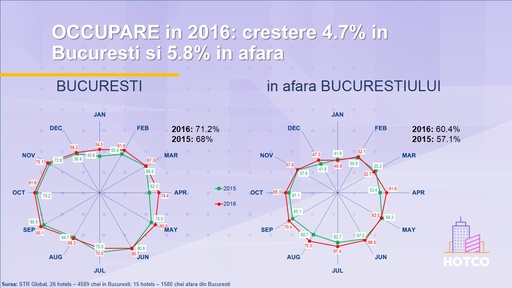
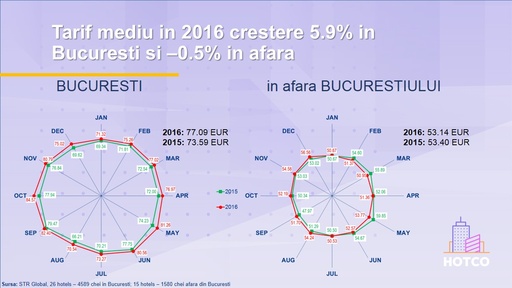
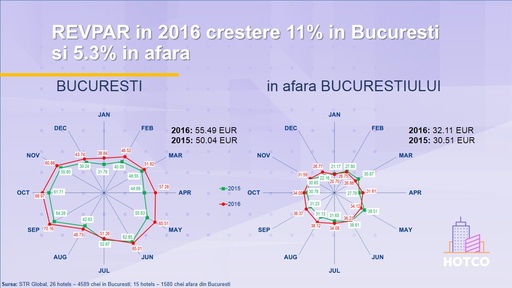
- Both international chains present in the discussion confirmed interest in cities in the ~300k inhabitant category and those in the ~200k inhabitant category, highlighting that Bucharest has only 43% of its hotel capacity affiliated with international brands and that this figure could easily reach 60% in the future. At the national level, the potential is even greater; only 7% of accommodation capacity is affiliated. Romania is a country where distances between cities are large enough that it is harder to resolve business trips with a return to the capital on the same day—a situation similar to Poland, another argument for why Romania can host the next investment boom in the field.
The list of hotel openings affiliated with international chains was discussed in detail, considering the type of investor (foreign/Romanian), the type of contract, and which operating model is most suitable in Romania in different situations, as well as future plans:
- HILTON GARDEN INN Bucharest City Center (200 keys – 2017)
- DoubleTree by Hilton Hotel Cluj – City Plaza ( 85 keys – 2017)
- Mercure Bucharest Unirii Square (97 keys – 2017)
- Ibis Styles in Arad (72 keys – 2017)
- Doubletree by Hilton in Ploiesti (245 keys – 2017)
- Hampton by Hilton Iasi (123 keys – 2017)
- Mercure in Brasov (120 keys – 2019)
- Ibis Styles Bucharest (160 keys – 2019)
- Radisson Brasov (105 keys – 2019)
- Novotel – secondary city in Romania (2020)
- Sheraton extension in Bucharest + congress hall + spa (100 keys).
Bogdan Stanciu highlighted aspects he learned by virtue of owning ~60% of the software sales market for hotel business administration (MICROS-FIDELIO, ORACLE Hospitality) and having personal relationships with most owners in Romania. There are major problems in the area of securing a qualified workforce, a lack of serious local management companies (so-called WHITE-LABEL) to ensure operation in situations where only a franchise agreement is available, and the importance of technological choices during project development.
Finally, the increasingly positive perception of ROMANIA as a safe country for tourism was noted, and the main reasons why we should face unprecedented interest in the coming period were reviewed:
- Poland no. 2;
- Excellent macroeconomic situation;
- Geopolitical stability;
- Depth of the city structure;
- Important international events in the next 5 years;
- Significant tourism potential and important steps taken in its management;
- Very attractive fiscal incentives.
The conference was opened by Chairman Khalaf Ahmad Al Habtoor, his group of companies being a significant investor in the region, owning the Intercontinental and Ritz-Carlton hotels in Budapest as well as two office buildings, Rumbach Centre and Dorottya Udvar. At the same time, during the conference, Deutsche Hospitality announced the opening of the first Intercityhotel in Eastern Europe, in Budapest, in 2019.
Source: Fivestar Hospitality
Frequently Asked Questions
Why is Romania considered “Poland II” for hotel investments?
Romania has a size and economic growth potential similar to Poland, benefiting from a dense structure of secondary cities and a low rate of affiliation with international brands.
What fiscal incentives stimulate tourism in Romania?
Measures include reducing VAT to 9% for accommodation and food services, introducing a specific profit tax, and income tax exemptions for employees.
Which cities have the highest potential for new hotels?
Besides Bucharest, secondary and tertiary cities like Cluj-Napoca, Iasi, Timisoara, and Brasov are attracting major interest due to international events and growing airport traffic.