
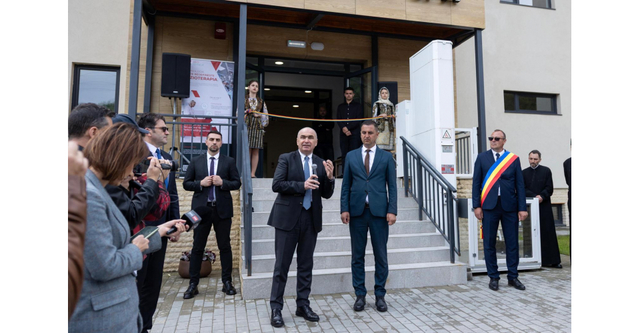
The first spa complex built from scratch in Romania in the last three and a half decades has opened its doors in the commune of Vizantea-Livezi, Vrancea County, in the presence of interim Prime Minister Ilie Bolojan. The project, which marks the relaunch of a historic resort destroyed during World War II, represents an investment made through the National Investment Company (CNI), funded by European funds, the state budget, and the local budget.
The investment value amounts to approximately EUR 7.05 million, to which a local contribution of 10% was added. The new treatment facility features indoor and outdoor pools, rooms for hydrotherapy, electrotherapy, and physiotherapy, saunas, a fitness room, accommodation spaces, and a restaurant. The reconstruction of the resort, whose efforts began in 2012 and works took place between 2022 and 2025, capitalizes on the local sulfurous and salty mineral waters, known for over 130 years and therapeutically comparable to those in the Govora, Călimănești, or Căciulata resorts.
The relaunch of the complex is part of a broader public and private investment program estimated at over EUR 50 million, aimed at modernizing infrastructure and developing a photovoltaic park for energy independence. Authorities estimate that the resort will be able to accommodate up to 400 people daily and will create over 60 jobs for the local community. For the first weekends of operation, rates start from EUR 123.5 per person (May 22-24 period), and from EUR 205.8 per person for the mini-holiday from May 29 to June 1.
Frequently Asked Questions
Where is the new spa complex located?
The new spa complex is located in the Vizantea-Livezi commune, in Vrancea County, Romania.
What is the value of the investment in the Vizantea-Livezi resort?
The investment in the new spa facility amounts to approximately EUR 7.05 million, funded through the National Investment Company (CNI), European funds, and state and local budgets.
What therapeutic properties do the waters in Vizantea-Livezi have?
The resort capitalizes on sulfurous and salty mineral waters, known for over 130 years, which are therapeutically comparable to those in Govora, Călimănești, and Căciulata.