
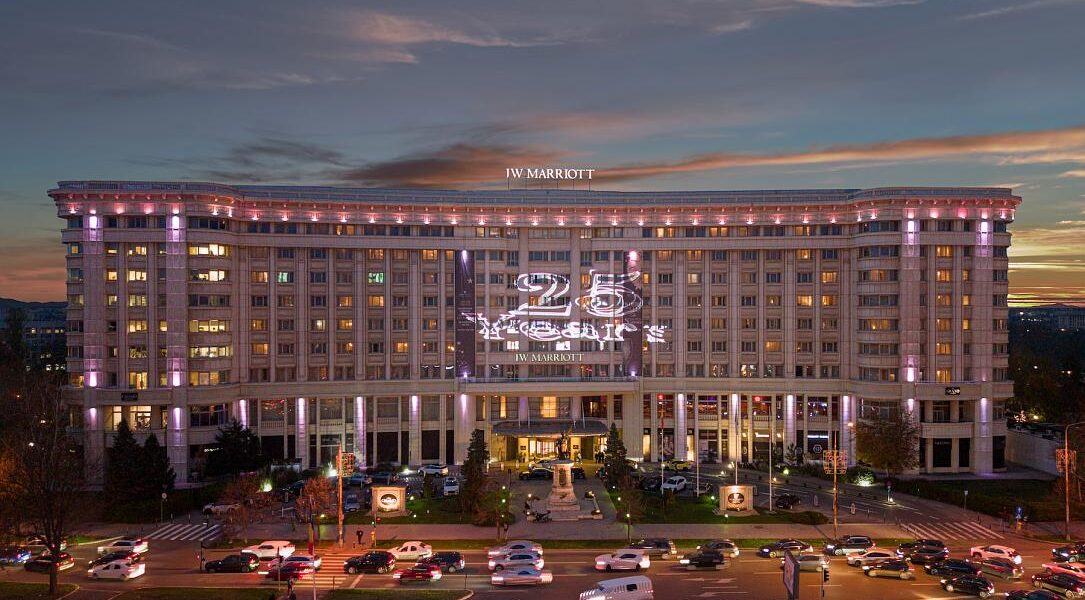
Following the 25th anniversary of the JW Marriott Bucharest Grand Hotel, Business Review conducted a double interview with Ioan Mătieș, General Manager of the Bucharest property, and Pankaj Birla, Marriott International’s Regional Vice President for Eastern Europe. The dialogue highlights the evolution of Romania’s hospitality sector from a post-transition market to a competitive regional hub. Key takeaways include Marriott’s aggressive expansion into secondary Romanian cities, the shifting demands of corporate clients, and data-driven projections for travel trends through 2026.
Preserving Legacy Through Adaptation
According to Ioan Mătieș, maintaining the relevance of a 25-year-old flagship property requires “intentional evolution.” The hotel has recently undergone significant transformations of its conference center, public spaces, and the Vienna Lounge. These capital improvements are designed to bridge the gap between legacy luxury and the requirements of the “next generation of travelers,” who prioritize technology, sustainability, and design.
Mătieș emphasizes that the modern guest profile has shifted significantly. Today’s travelers—both corporate and leisure—are more informed, value efficiency, and seek a blend of business and leisure utility. Consequently, the hotel’s strategy focuses on operational agility, particularly regarding MICE (Meetings, Incentives, Conferences, and Exhibitions) capabilities, offering modular spaces that cater to refined corporate expectations.
Regional Expansion and Market Pipeline
Pankaj Birla identifies Eastern Europe as one of Marriott’s most dynamic growth clusters, with Romania acting as a central pillar due to its mix of commercial development and untapped tourism potential. Marriott currently operates six properties in the country, but the strategic focus is shifting beyond the capital.
Birla outlined a robust three-year pipeline that includes:
-
Expansion into key regional hubs: New properties are anticipated in Sinaia, Timisoara, and Sibiu.
-
Resort segment entry: A signed agreement for a Courtyard by Marriott in Calimanesti, marking the group’s first hotel in a Romanian resort destination.
This expansion is supported by growing connectivity, with direct flights linking Romania to key markets in Europe, the Middle East, and the US.
Competitive Positioning and Brand Strategy
Addressing the tightening competition in Bucharest’s luxury segment, Birla points to Marriott’s global brand portfolio—comprising over 30 brands, including seven in the luxury tier—as a primary differentiator. Post-pandemic consumer behavior has favored trusted legacy brands.
A critical competitive moat remains the Marriott Bonvoy loyalty program, which now serves over 260 million members globally. This ecosystem drives guest preference and provides stability against new market entrants.
Human Capital Strategy
In the context of Romania’s tight labor market, Mătieș identifies talent retention as a strategic asset rather than a human resources function. The JW Marriott culture prioritizes internal mobility, with many current leaders having started in entry-level roles. The strategy relies on structured development pathways and cross-exposure to mitigate turnover and maintain service consistency.
Future Outlook: AI, “Lux-scaping,” and 2026 Trends
Looking toward the next decade, both executives forecast a blurring line between business and leisure travel. Mătieș predicts a more mature, international market where properties must offer a “complete ecosystem” of wellness, connectivity, and business capability.
Birla cited data from Marriott Bonvoy’s recent “Ticket to Travel” report regarding trends for 2026:
-
Sustained Demand: 79% of travelers in the EMEA region plan to maintain or increase their travel frequency in 2026.
-
AI Adoption: 50% of travelers now use Artificial Intelligence for trip planning, a significant rise from 26% two years prior.
-
Emerging Behaviors: The market is seeing a rise in “Lux-scaping” (booking luxury stays as indulgences to bookend holidays) and “Passion Pursuits” (travel driven by musical, cultural, or sporting events), particularly among Gen Z and Millennials.
This summary is based on an interview originally conducted by Business Review.