
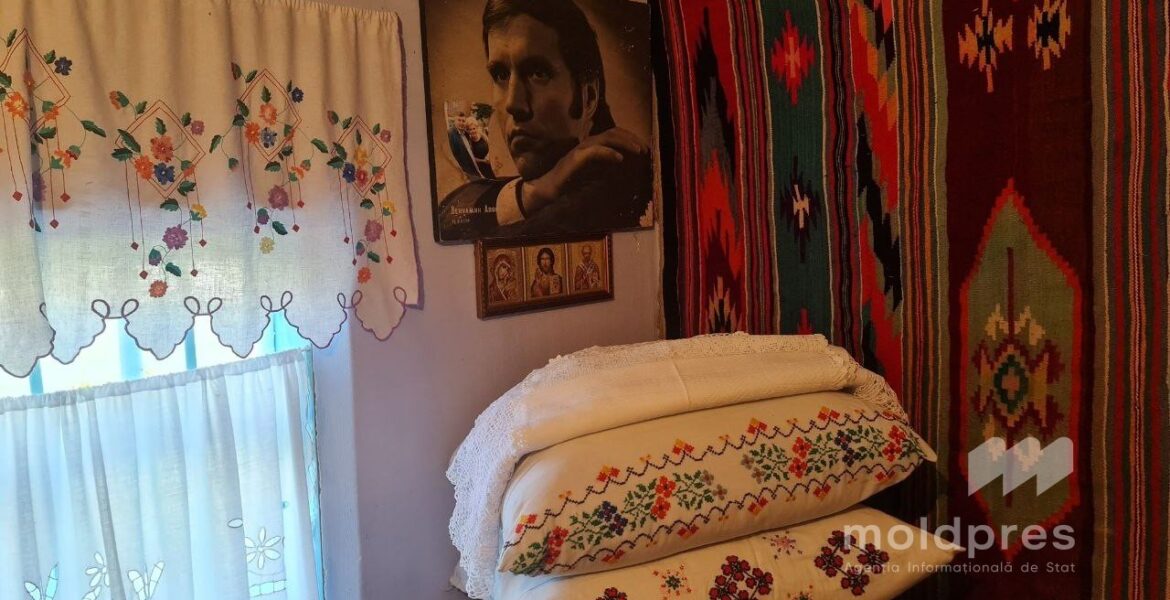
The childhood home of actor and director Veniamin Apostol, a traditional building over 200 years old from the village of Dubna, Soroca district, is preserved as a space of cultural memory and heritage, according to the MOLDPRES agency. Cared for by Lucia Apostol, the artist’s niece, the house preserves elements of vernacular architecture and historical pieces with symbolic value, representing a reference point for the cultural history of the Republic of Moldova.
The house, made of wattle and daub, houses heritage objects passed down through generations, including a bicentennial carpet and the wooden bench (laiță) where the artist spent his childhood. Born on August 15, 1938, in Dubna, Veniamin Apostol made a major contribution to modernizing directing and promoting national dramaturgy. A graduate of the “G. Musicescu” Institute of Arts in Chișinău, he completed his directing studies in Moscow under the guidance of professor Anatoly Efros. From 1968, he worked as a director at the “Mihai Eminescu” National Theatre (formerly the “A. S. Pushkin” Academic Theatre), where he staged landmark performances based on texts by Dumitru Matcovschi, Ion Druță, Aureliu Busuioc, and Alexei Marinat. In parallel, he trained generations of actors and directors as a professor at the Institute of Arts in Chișinău, being recognized for his innovative style that combined realism with poetic expressiveness until his death on December 14, 2000.
Frequently Asked Questions
Where is the historical house of Veniamin Apostol located?
The house is located in the village of Dubna, Soroca district, in the Republic of Moldova.
How old is the house and what is it made of?
The traditional house is over 200 years old and was built using wattle and daub.
Who was Veniamin Apostol?
Veniamin Apostol (1938–2000) was a prominent Moldovan actor, director, and professor who made significant contributions to modernizing theater directing and promoting national dramaturgy.