
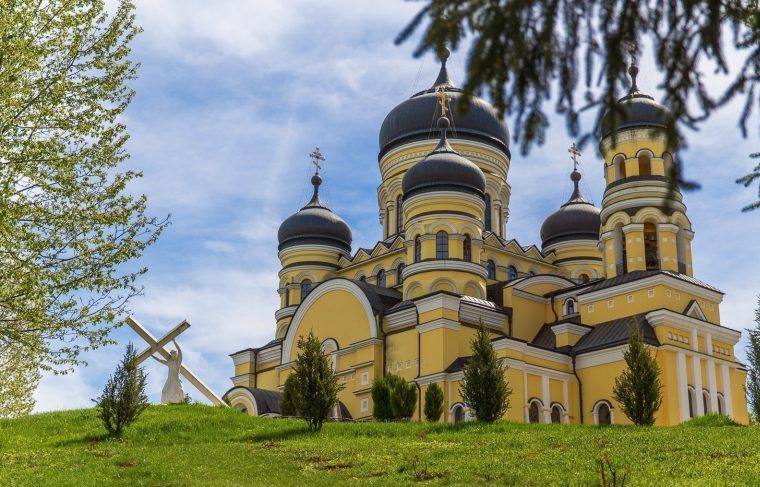
Moldova is a country with a rich religious tradition and a long history of monasteries. These historical monuments have withstood the test of time and have become an important tourist destination for those interested in spirituality and culture.
These are some of the most beautiful monasteries in Moldova, places where architecture and religious art blend with the natural beauty of the surrounding landscapes:
- Căpriana Monastery
In a picturesque forest area (codru), 40 km northwest of Chișinău, lies one of the oldest monasteries in Moldova – Căpriana (founded in 1429). For a long time, it served as the residence of the Metropolitan of Moldova and was patronized by rulers, including Stephen the Great. The chronicler Eftimie and one of Moldova’s first poets, Chiprian, lived here.
Initially, the monastery was built entirely of wood, but later, in 1545, the summer church “Dormition of the Mother of God” was erected in stone. In 1840, the “St. George” church was built, and in 1903, “St. Nicholas.” Căpriana also housed the largest monastic library in Moldova, featuring precious princely gifts. Closed and devastated during the post-war years, it was among the first to reopen in 1989, quickly becoming a symbol of national rebirth. The monastery can be visited daily.
Other objectives that can be visited in the area include the “Căpriana-Scoreni” landscape reserve, Stephen the Great’s Oak, and the oldest reserve in Moldova – “Codri.”
- Hâncu Monastery
In 1678, in a forest area at the source of the Cogalnic River (approx. 55 km west of Chișinău), the Great Seneschal (Stolnic) Mihail Hâncu founded a convent at his daughter’s request. During the 17th century, the wooden churches and monastic cells were frequently devastated by Tatar invasions. Because of this, the “St. Parascheva” monastery was periodically deserted. In 1835, the summer church was built in stone in the Russian-Byzantine style, followed by the winter church in 1841.
Between 1956 and 1990, the monastery was closed by Soviet authorities, and its territory served as a rest and treatment base for the Ministry of Health. In 1990, at the request of locals from neighboring villages, the Hâncu monastery was reopened, shortly becoming one of the most well-maintained and visited monastic communities by tourists.
Several water-rich springs are found near the monastery, one of which has high mineralization.
- Hîrjauca Monastery
Hîrjauca Monastery is a monastery for monks located 70 km northwest of Chișinău, in the Hîrjauca commune. A monastic community first appeared in this forest area in 1740; later, wooden churches and cells were built. In the first half of the 19th century, Hîrjauca Monastery experienced a flourishing period, being situated in a park landscaped with lakes, fountains, and alleys. The “Ascension of the Lord” summer church was built in 1836, its classical architectural structure closely resembling the Cathedral in Chișinău. Later, the “St. Spyridon” winter church was also constructed. The monastery had an impressive library and a school for the children of the clergy. In 1922, the interior of the “St. Spyridon” church was painted by the famous artist Pavel Piscareov. However, during the Soviet period, the monastery was closed and a treatment resort was opened on its grounds. In 1993, the monastery reopened.
The “Spring of Youth,” which has special curative properties, is also located here. Visitors to this area can take a trip through the local forest, considered a valuable natural botanical monument.
- Japca Monastery
The locality of Japca (160 km north of Chișinău) is well known to visitors of Moldova for its convent, which was the only one functional during the Soviet period. Since its founding in the 17th century, the monastic community built its settlements to closely resemble fortifications. The first dating of the hermitage is attributed to 1693, when the founders lived in cave cells and held services in the rock church. In 1770, the monks settled on the site of the current monastery. At that time, construction and household improvements began. Later, a rich library was founded. At the beginning of the 19th century, stone churches were built. The most important church in the monastery has been rebuilt several times. Today, this church has three altars: “Ascension of the Lord,” “Transfiguration,” and “Holy Cross.”
Other equally interesting objectives in the nearby area include: the “Japca Rock” geo-paleontological monument, a mineral water spring, landscape reserves at Rașcov and Valea Adâncă, ancient fortifications, and Paleolithic sites at Socola and Rașcov. The “Nistru” sanatorium operates in the town of Camenca.
- Noul-Neamţ Monastery (Chiţcani)
In the 15th-17th centuries, the territory of Moldova was covered by a dense network of monasteries and hermitages, thanks to the extensive patronage of rulers such as Alexander the Good, Stephen the Great, Petru Rareș, and others. In total, 70 monastic settlements operated within the Romanian Principalities. Among the monasteries for monks, the Neamț monastic site was the most significant.
Neamț Lavra, founded in the second half of the 14th century, is one of the oldest and richest monasteries in Moldova, which over five centuries affirmed its importance as a great center of culture and spread the fame of its traditions far beyond the borders of Moldova.
Neamț Monastery was founded by the monks Sofronie, Pimen, and Silvan. According to one version, these monks came to the mountains of Moldova from the south, possibly being disciples of Saint Nicodemus of Tismana. According to another version, they may have come from the Holy Mount Athos.
The first church was built in the monastery by Petru I Mușat (1375–1391). Voivode Petru I also gifted the monastery “several villages at the mouths of the Neamț, two mills, and two vineyards.”
- Rudi Monastery
Located in the north of the republic, approx. 200 km from Chișinău, the village of Rudi is one of the most interesting localities to visit. Here we discover prehistoric remains in a natural cave of about 100 m, an exceptional landscape reserve, ancient promontory fortifications (4th-3rd centuries BC), two circular earth fortresses (9th-12th centuries) “Farfuria Turcească” and “Germanariu,” and a rural community with rich traditions. However, the main attraction in the area is one of the oldest monasteries in Moldova. For several centuries, the monastery for monks preserved a traditional monastic lifestyle, and the “Holy Trinity” church, erected in 1777, is considered a representative sample of the old Moldovan style of religious architecture. The church is located in an extraordinary natural setting in the valley of the Bulboana River, a right-bank tributary of the Dniester.
- Saharna Monastery
Located in the north of the republic, approx. 110 km from Chișinău on the right bank of the Dniester River, the “Holy Trinity” monastery of Saharna is rightfully considered among the largest centers of religious pilgrimage in Moldova. Found here are the only relics of St. Macarius the Pious in the republic, and on one of the rocks—a footprint left, according to legend, by the Mother of God. It is said that one day, the enlightened face of the Mother of God appeared to a monk from the old cave monastery (according to documentary evidence from the 17th-18th centuries, the monastery has functioned since the 10th-12th centuries) on one of the high rocks. Reaching the rock, the monks discovered a footprint on the stone, a sign they considered a divine announcement and a testimony to the “divine purity” of the place. Soon, closer to the defile, a new wooden church was built and the “Holy Trinity” monastery was founded (1777). Later, a stone church in the old Moldovan style, richly decorated with wall frescoes, was erected on the site of the wooden church. Over time, the monastic community in the monastery increased.
- Țipova Monastery
At Țipova, on the rocky bank of the Dniester (approx. 100 km north of Chișinău), lies the largest Orthodox cave monastery in Moldova, also considered one of the largest in Europe. The monastic community here existed long before the formation of the feudal state of Moldova. It is believed that some cells were dug into the steep cliffs of the Dniester during the 10th-12th centuries (according to other data, the 16th-18th centuries). A period of prosperity began in 1776, when the monastery expanded southward. The cave church was partitioned into large spaces separated by massive columns. During the Soviet period, the monastery was closed and devastated. In 1975, the ruins of the Țipova cave monastery were taken under state protection, and in 1994, divine services were resumed. It is said that in this monastery, the ruler of Moldova, Stephen the Great, married his wife Maria Voichița, while another legend claims that the mythological poet Orpheus spent his last years among these rocks and is buried in a niche of a waterfall in the canyon.
- Ciuflea Monastery
The monastery is located not far from the historical center of Chișinău – Great National Assembly Square, on 12 Ciuflea Street. The Monastery Cathedral is a white stone temple with nine gilded domes, built by the brothers Teodor (1796-1854) and Anastasie (1801-1870) CIUFLI, and is popularly known as the “Ciuflea Monastery.” The construction of the cathedral began in 1854 and was completed in 1858. The founders and benefactors of the holy place, brothers Teodor and Anastasie, are buried near the southern wall, a fact attested by the inscription on the marble plaque inside the monastery cathedral.
- “St. Great Martyr James the Persian” Monastery – Sireți village, Strășeni district
In the heart of Bessarabia, 16 km from Chișinău, the Monastery of Saint Great Martyr James the Persian stands watch like an open eye of the sky between green hills—a contemporary monastic foundation that seeks not to shame tradition but to continue it creatively. The village of Sireți, where the monastery is located, is in the Strășeni district, a village with old traditions rooted back to the time of Saint Voivode Stephen the Great, whose soldiers came from the Vrancea mountains on the Siret valley to be closer to the border threatened and trampled by pagan hordes.
- Vărzărești “Birth of the Mother of God” Monastery
Vărzărești Monastery is the foundation of the boyar Stan Vărzari, a contemporary of the ruler Alexander the Good (1399-1432), who became famous in the country precisely through the founding and consecration of this monastery, which bears his name.
It is not exactly known what feelings prompted this boyar to raise a holy place, but there is undoubtedly an anonymous memory with ancestral sources, having a folkloric nuance, in whose reflections this event was hyperbolically transfigured, becoming a legend.
Frequently Asked Questions
What is the oldest monastery in Moldova?
Căpriana Monastery is one of the oldest, with its first recorded founding dating back to 1429.
Which monastery was the only one to remain open during the Soviet era?
Japca Monastery was the only monastic community in the Republic of Moldova that remained functional throughout the entire Soviet period.
Where can I find the largest cave monastery in Moldova?
The largest Orthodox cave monastery in Moldova, and one of the largest in Europe, is located at Țipova, on the rocky banks of the Dniester River.