
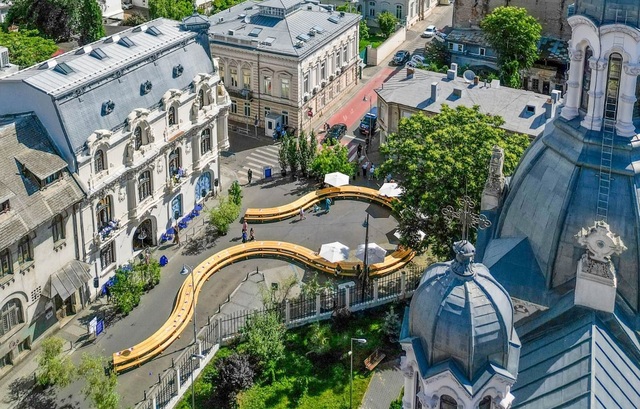
Amzei District 2030: Private Urban Regeneration Plan
ARCEN and La Mița Biciclista have launched “Amzei District 2030,” a private urban regeneration project for the historical area bounded by Calea Victoriei, Piața Romană, Mendeleev Street, and George Enescu Street. The initiative proposes an integrated Masterplan for the neighborhood’s development, in the context where the Capital City Hall recently designated Piața Amzei as a priority regeneration zone, and General Mayor Ciprian Ciucu and Sector 1 Mayor George Tuță agreed on the pedestrianization of the segment between Amzei Church and the square.
The project is structured on eight strategic directions: heritage, mobility, public space, local economy, community participation, culture, infrastructure and seismic risk, and climate and sustainability. The implementation strategy will go through three stages: establishing a civic initiative bringing together residents, entrepreneurs, the French Embassy, and Amzei Church; conducting an independent urban-sociological study; and organizing an international project competition. Edmond Niculușcă, president of ARCEN, emphasized that the research results will be offered free of charge to authorities to ground public interventions on real data and transparency.
The endeavor aims to harmonize the needs of all local actors, avoiding punctual interventions without an overall vision. The expertise of private partners is supported by ARCEN’s 20 years of activity in urban planning (with 20,000 buildings documented in Catalog București) and the success of the cultural hub La Mița Biciclista, which manages 70 employees and attracts over 300,000 visitors annually to the capital’s center.
Frequently Asked Questions
What is Amzei District 2030?
It is a private urban regeneration project launched by ARCEN and La Mița Biciclista for the historical Amzei area in Bucharest.
Who are the partners involved in this project?
The initiative brings together residents, local entrepreneurs, the French Embassy, Amzei Church, and local authorities.
What are the main directions of the masterplan?
The project focuses on heritage, mobility, public space, local economy, culture, infrastructure, and sustainability.