
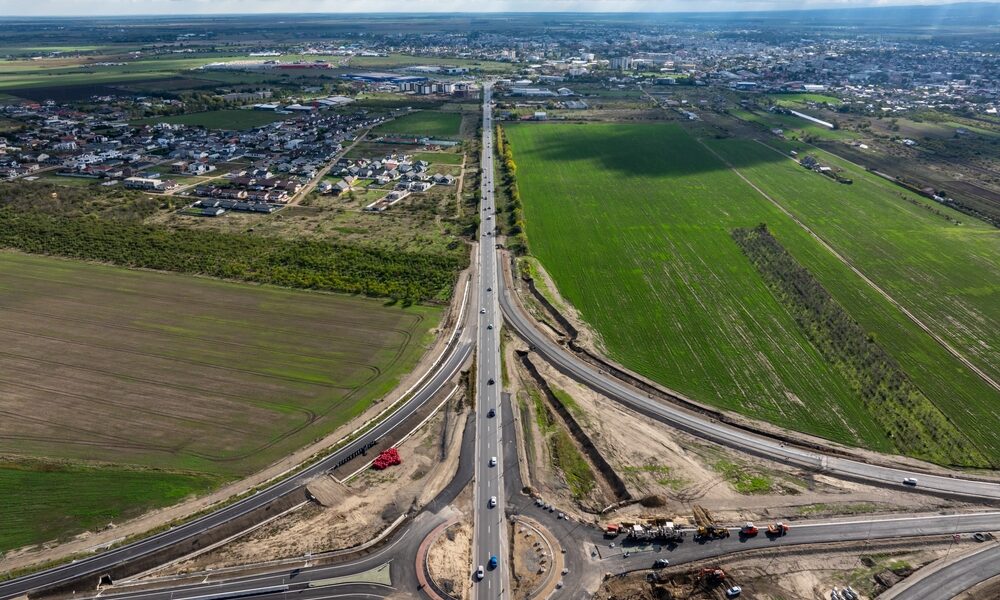
A new 47-kilometer section of the Moldavia Motorway (A7), between Adjud and Bacău, will open to traffic on Monday, August 31, announced Prime Minister Ilie Bolojan. With the inauguration of this segment, the operational network of the A7 will reach approximately 242 kilometers out of the total 319 kilometers planned between Ploiești and the northern region, enabling high-speed road connections of over 300 kilometers from Bucharest along the A3–A7 route.
Final works are being completed near the junction with the Bacău Bypass. On the motorway route, the 77-kilometer Bacău–Pașcani section remains under construction; its works have been financed so far through the NRRP, with the necessary funding after August 31 to be provided from the state budget. For the northern extension of the A7, construction contracts were extended into 2026 for the Pașcani–Suceava sector and subsequently toward Siret, at the border with Ukraine. These segments, along with the Pașcani–Iași–Ungheni section of the Union Motorway (A8), are included in the European SAFE instrument, benefiting from funds under the EUR 4.2 billion allocation designated for dual-use, civil and military infrastructure. In parallel, the prime minister noted that over 2,500 NRRP investments remain to be completed, warning that projects unfinished by August will be taken over at local authorities’ expense, and disbursed funds will have to be returned if the objectives are not ready by the end of the year.
Frequently Asked Questions
When does the Adjud – Bacău section of the A7 motorway open to traffic?
The new 47-kilometer section opens to traffic on Monday, August 31.
How many kilometers of the A7 motorway are operational after this opening?
The operational network reaches roughly 242 kilometers out of the planned 319 kilometers between Ploiești and the north.
How are the remaining northern sections and connecting motorways funded?
The Bacău–Pașcani section transitions to state budget funding, while the Pașcani–Suceava–Siret extension and parts of the A8 motorway are backed by the EU’s SAFE dual-use infrastructure fund.